About

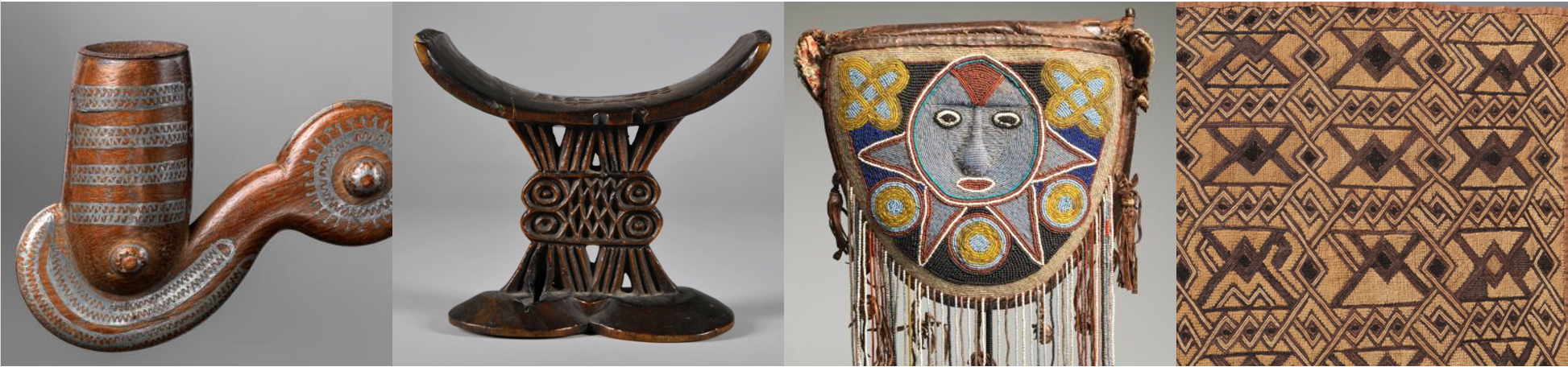
Kuba cloths are made of felted barkcloth created by both men and women. Traditionally, men grow a variety of palm trees (Raphia tectiliswelw.) that yields particularly long fronds. Once harvested, the men weave the fiber culled from the outer layers of the fronds on diagonal looms, resulting in the small square panels. Then both men and women decorate the squares with embroidery, applique, patchwork, and dye. The examples displayed here are all made by women using cut-pile embroidery.
Here the cloths are displayed separately, but in their traditional context the individual squares would be sewn together to create one long textile, often as long as nine yards in length. The effect is a patchwork-style textile combining diverse designs by individual members of the community, both uniting and contrasting with the border designs that link the sections together.
The geometric patterns and stylistic designs seen repeated throughout the textiles resonate with patterns found on Kuba architecture, as well as functional and prestige objects. The patterns speak to Kuba notions of social status and spirituality, but the cloth squares themselves served a variety of functions such as currency that could be used as a dowry and as a way of settling disagreements. It played a part in court ceremonies, and, perhaps most importantly, these textiles are seen as clothing of the ancestors and, once sewn together, serve as burial cloth demonstrating the status of the dead.