Gift of Charles S. Ackerman and Joanne McGill-Ackerman. 2017.32.125
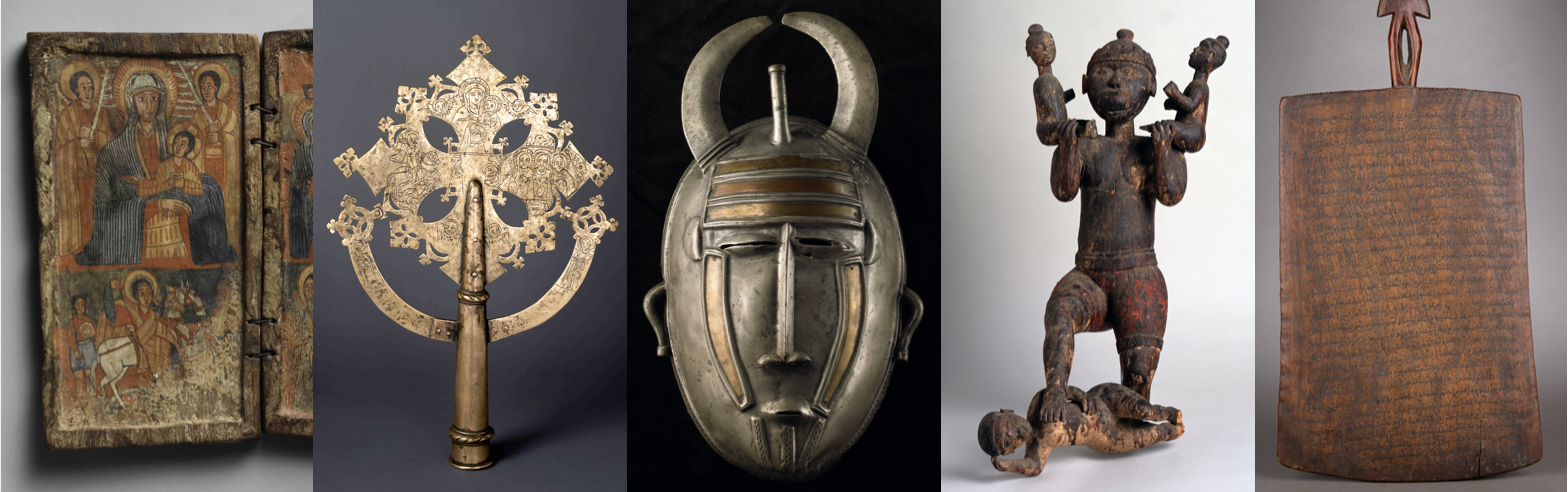
Islam became the official religion of the Mali Empire in the thirteenth century, but came to prominence during the fourteenth-century reign of Mansa (king) Musa Keita I, who famously made a pilgrimage to Mecca, or Hajj, in 1324. In some cases the imagery and practices described by Islamic traditions remain intact; in other cases they mix with cultural customs, beliefs, and stories, creating distinct religious institutions. Objects such as the do muso mask, displayed here, are a fusion of Mande culture and Islamic elements.
The Dyula, meaning “trader,” are a subset of the Mande ethnic group, known primarily as traders and merchants. They originated in the Mali Empire and began to settle in the Kong region of Côte d’Ivoire in the sixteenth century. Kong was well-situated as a trading point between the savannah and forest, becoming a commercial center as well as a center for Islamic study – scholarship networks are often closely linked to trade networks. As a trading post, blacksmiths had access to imported European metals, which feature prominently in this Do muso mask.
The Do society was originally established by Sonongui warriors and Muslim ritual specialists to protect the trade routes around the city. Do, meaning secret knowledge, was an exclusive organization, open only to initiated men. The Do society changed greatly after the fall of Kong in 1897 and the widespread conversion to Islam. Today it serves as an entertainment society that performs for the public, rather than as a warriors’ secret society. Do Muso is known as the beautiful maiden and is one of fifteen early metal masks known to exist. The maiden mask has an idealized feminine face, characterized by fine modeling and exceptional casting. The delicate ornamenting includes flat eyebrows, small protuberances near the ear, scarification, and horns, a Mande feature associated with containers for secret knowledge, perhaps similar to the horns featured on the Malinke hunter’s shirt nearby.