About

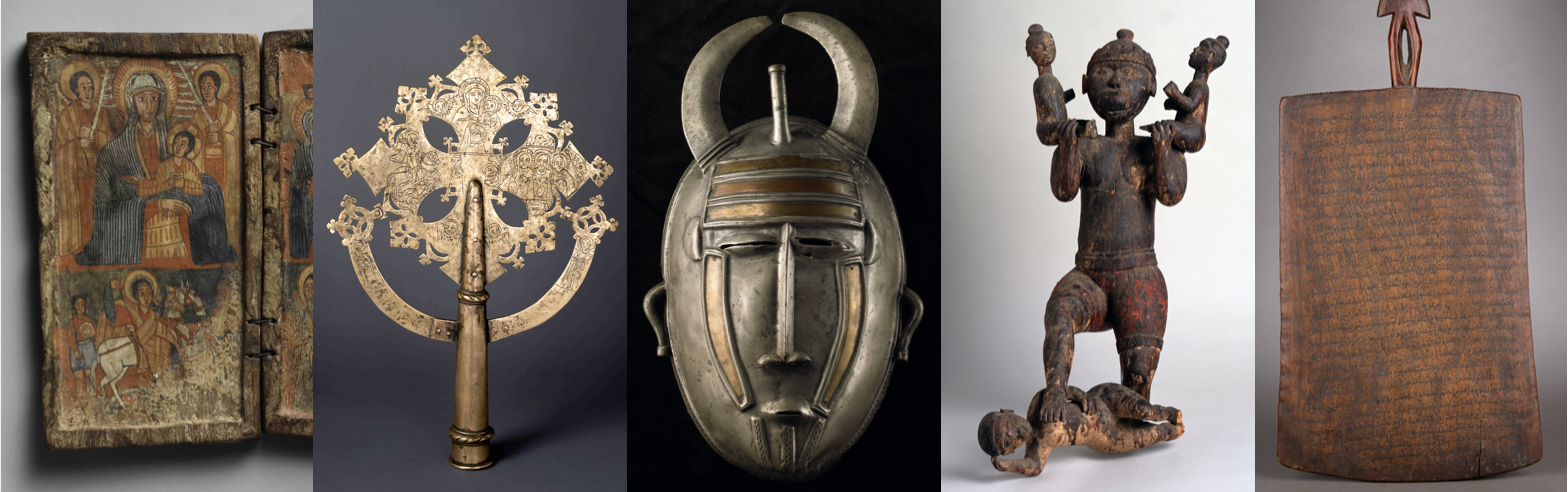
Koranic Writing Board
Hausa (Nigeria)
20th century
Wood, paper, and pigment
Gift of Charles S. Ackerman and Joanne McGill-Ackerman. 2017.32.89
Koranic Writing Board
Ethiopia
Late 19th century
Wood and pigment
Gift of Gail and Clark Goodwin, Clara O’Shea, and Joyce Flueckiger. 2017.41.1
Muslims believe that the Qur’an is the word of God transmitted directly to the prophet Muhammad ibn ‘Abdullah and transcribed in the Islamic holy book. In Islamic communities across Africa, children attend Qur’an school to study Arabic and writing boards like this one are used by students learning to read, write, and recite verses of the Qur’an.
Typically, in sub-Saharan Africa, ink made from water, gum Arabic, and charcoal is used to inscribe a verse on the tablet, the act of writing itself considered a sacred act. Once memorized, the ink is either scraped off as seen in tablet 1 or erased with water in order to write the next verse, the method used in tablet 2. The water, now imbued with the word of God, is believed to have healing properties and may be drunk or saved for children when they become ill.
The dark script of the most recent lesson is visible, but upon close examination one can see remainders of previous lessons, the layers of calligraphy fading into the rich patination of the board's surface and documenting the legacy of this boy’s education.