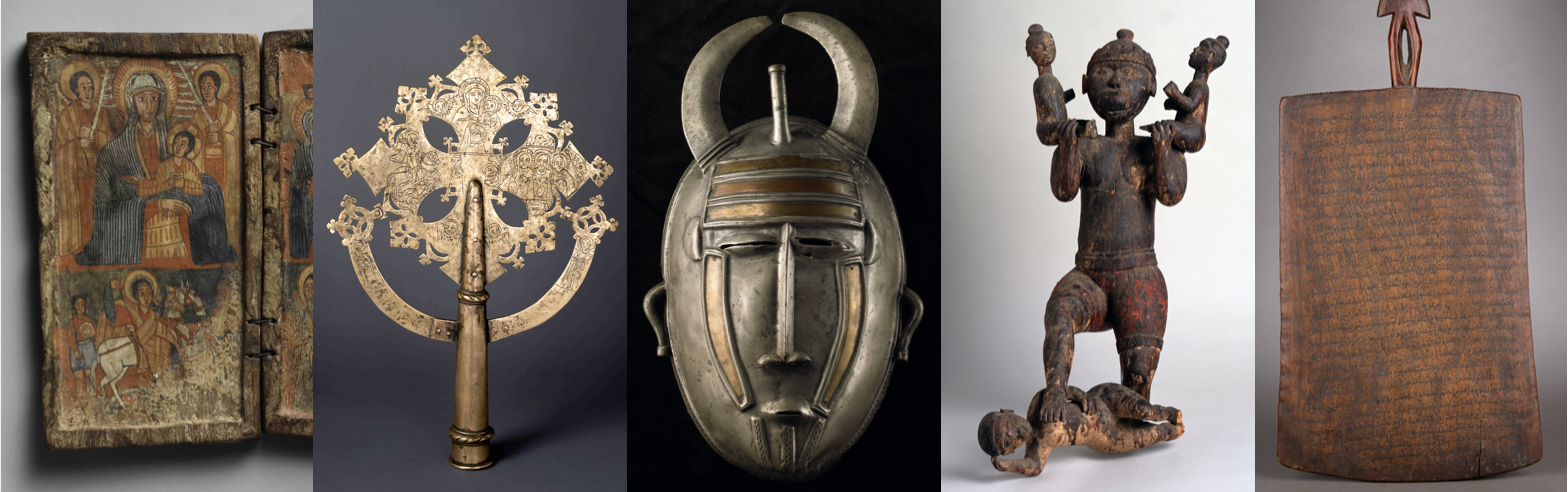
Christianity spread throughout Ethiopia as early as the fourth century with the founding of the Ethiopian Orthodox Tawahido Church in 333 CE. The Ethiopian Coptic Church has a unique artistic practice influenced by Byzantine and medieval art, and is centered around the Ethiopian cross. As seen here, the Ethiopian cross is intricate and abstract in design, with geometric and often lace-like patterning ornamenting the central cross. Large brass crosses are mounted on wooden shafts, accented by colorful ribbons and processed during the service.
The processional cross displayed here is full of imagery: The scene of “mother and child enthroned” was informed by the Byzantine icon of the Virgin Salus Populi Romani located in the Church of Santa Maria Maggiore in Rome. Prints of this icon were circulated throughout Ethiopia by Jesuit missionaries beginning in 1570. Transformed in the local context, the Santa Maria Maggiore icon is known as Our Lady Mary with Her Beloved Son. Another common scene of St. George slaying the dragon accompanies this depiction. Alternatively, certain Christian elements, such as the seraphim, are transformed into an Ethiopian vernacular of a face with wings.
On the opposing side of the cross the Crucifixion is placed at its apex. The patron who commissioned the cross incorporates himself into the scene and makes visible his devotion, lying prostrate beneath the scene of the Crucifixion. At the donor’s head is an icon of Christ, depicted as the Man of Sorrows, wearing the crown of thorns and holding his hands up in acceptance. This is called the Kwer’atä Reesu. The words incised below the icon of Christ are written in Ge’ez, an archaic language still used in Ethiopian liturgy. The inscription reads, “How Arkä Mär’awi made supplication,” identifying the donor and implying that he commissioned this cross to donate to the church.