East Africa saw Islamic traders from the Arabian Peninsula and Hindu sailors from South Asia as early as the eighth century, bringing their religious traditions with them, and creating a distinct culture along the Swahili coast. It would take another millennium for Hinduism to find a place in West Africa, arriving in Nigeria in two waves: first, in the early twentiethcentury, with the arrival of Sindhis, an ethnic group from present-day Pakistan. The Sindhis sought economic opportunity building the railroads in Nigeria as they had done in India, both of which were British colonies at the time. Another Indian community came when missionaries from the International Society for Krishna Consciousness first arrived in 1979 with guru Bhakti Tirtha Swami.
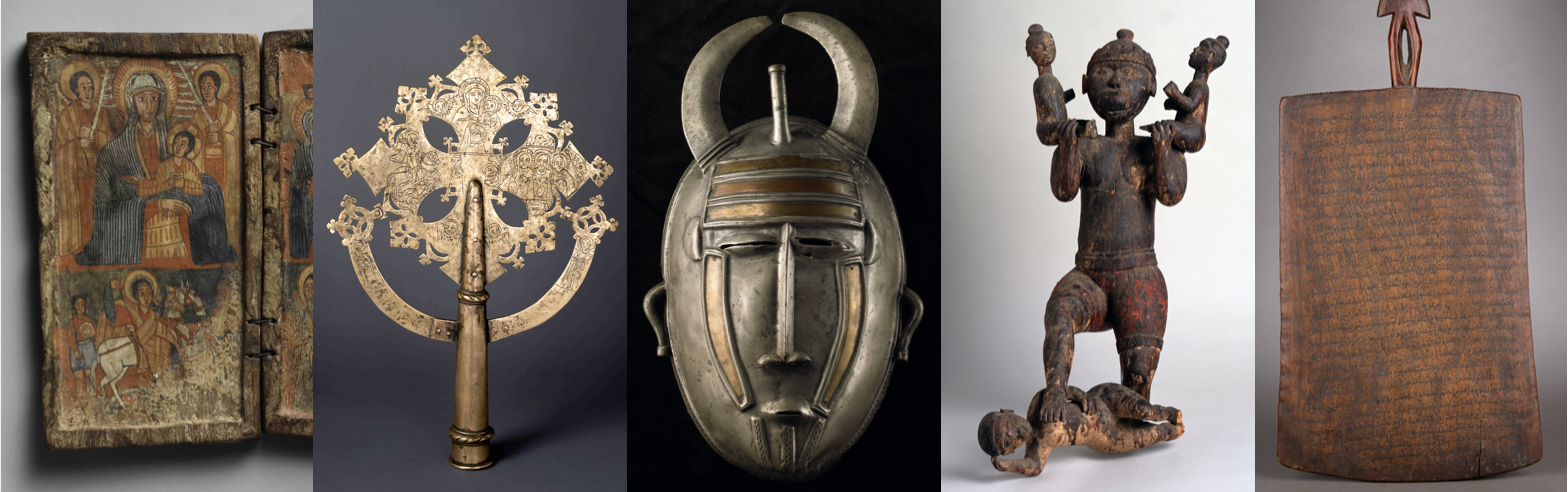
Hanuman is the simian-god, a key character in the Ramayana, the Sanskrit epic that recounts the life of Rama, an avatar of Vishnu. Rama and Hanuman meet in the fifth book of the Ramayana, when Rama is exiled from Ayodhya, the capital of his father’s kingdom. Rama and his brother Lakshmana search for Rama’s wife Sita, who was kidnapped by Ravana. In sculpture and print Hanuman is often depicted holding a scepter and Mount San Jeevani and standing with one leg on a rock, but here he appears carrying Rama and Lakshmana and trampling the giant Kalanemi, who was sent by Ravana to kill Hanuman.
As a sculpture enshrined, Hanuman is typically coated with offerings of ghee and painted with vermilion, which has antiseptic and healing properties, and demonstrates his fearlessness and assertiveness. This Hanuman has evidence of blood poured over it, suggesting that it was appropriated for another use.